
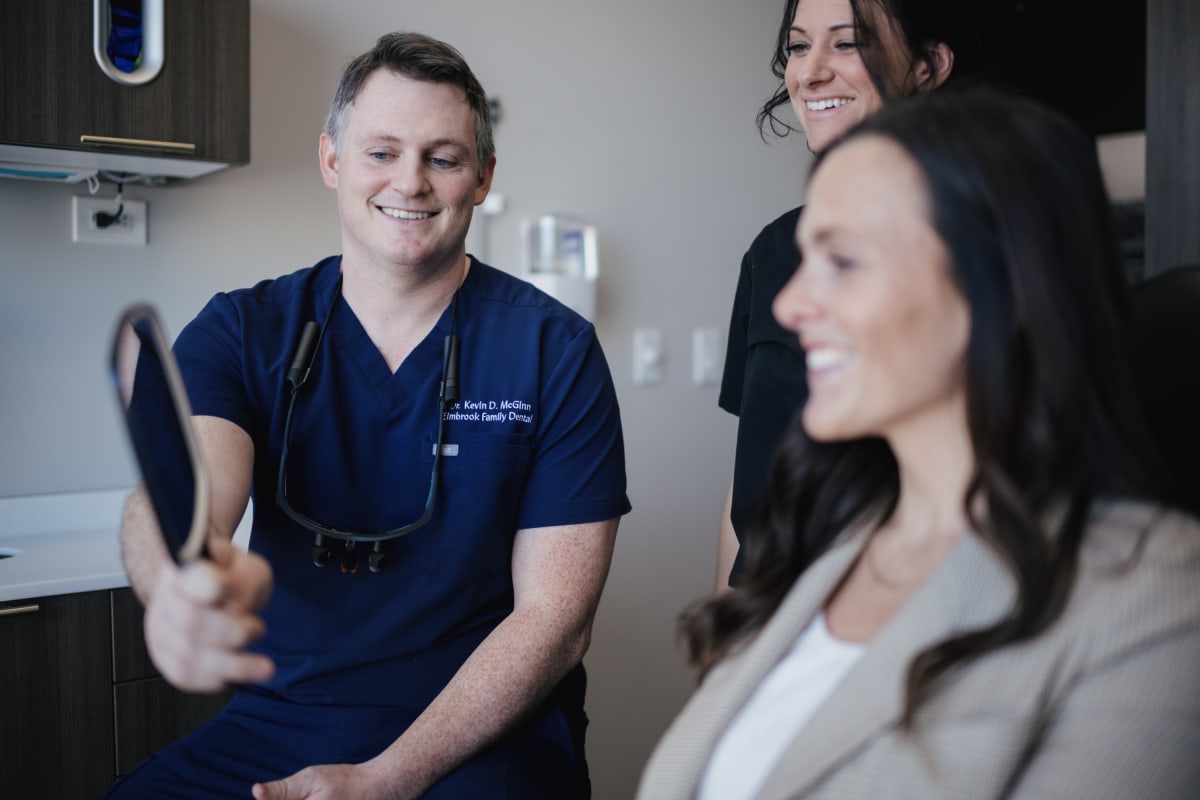
What Is Full Mouth Rehabilitation?
Full mouth rehabilitation is a coordinated series of restorative and sometimes cosmetic dental treatments designed to rebuild the function, health, and appearance of all or most of your teeth. It's not a single procedure. It's a personalized treatment plan that addresses multiple dental concerns together, in a thoughtful sequence, so everything works the way it's supposed to when you're done.
If you're dealing with worn-down teeth, missing teeth, old failing restorations, gum issues, and bite problems all at once, treating them one at a time without a bigger plan can actually make things harder. Full mouth rehabilitation brings all of those pieces into a single, organized roadmap.
At Elmbrook Family Dental, with offices in Brookfield and Wauwatosa, our team takes time to understand the full picture before recommending anything. Patients often tell us they appreciate how upfront and clear the whole process feels, which is exactly how it should be. You deserve to know what's happening in your mouth, why it matters, and what your options are.
This kind of care is built for people who have multiple concerns that need to be addressed together, not piecemeal. If that sounds like your situation, you're in the right place.
Quick Overview
- Full mouth rehabilitation is a multi-treatment plan, not a single procedure. It combines restorative work, such as crowns, implants, and fillings, with treatments that address bite alignment, gum health, and tooth structure.
- It's designed for patients with several interconnected dental concerns that can't be solved in one appointment at a time. Every plan is built around your specific situation.
- A comprehensive exam is the starting point where your care team understands what treatments will be required to achieve your health goals, how long it will take from start to end, and how much it will cost.
- Full mouth rehabilitation is typically staged across multiple appointments, sometimes over several months or longer. That's normal and intentional, and your care team should communicate clear expectations before you commit to the plan.
Who Is a Candidate for Full Mouth Rehabilitation?
A lot of patients who could benefit from full mouth rehabilitation never realize it's an option. They assume their situation is too complicated, too far gone, or just something they have to live with. But that's exactly the kind of case this approach was designed for: several interconnected dental concerns that no single procedure could realistically address on its own.
You might be a candidate if your situation sounds like one of these:
- You've put off dental care for years and now have a mix of cavities, missing teeth, old failing restorations, and gum concerns all happening at once.
- You've lost multiple teeth and the surrounding bite, bone, and remaining teeth have shifted or deteriorated as a result.
- You grind your teeth (bruxism) and the wear has flattened, cracked, or shortened your teeth to the point where your bite no longer functions the way it should.
- Acid erosion from diet, acid reflux, or other causes has worn away enamel across most of your teeth.
- An accident or injury affected several teeth at once, leaving you with a combination of fractures, missing teeth, or structural damage.
- You have a congenital condition that affects how your teeth formed, their strength, or how many developed in the first place.
None of these situations are rare, and none of them mean you're beyond help. What they do mean is that your care plan needs to be thoughtfully coordinated, not pieced together one appointment at a time.
Candidacy isn't something you can determine on your own, and we wouldn't expect you to. A comprehensive exam is the right starting point. At Elmbrook Family Dental, that exam gives our team the full picture so we can have an honest conversation about what's going on, what's possible, and what makes sense for your life and your schedule. Patients across Brookfield, Wauwatosa, Elm Grove, and the surrounding area tell us they appreciate how straightforward we are throughout that process.
Common Treatments Included in a Full Mouth Plan
Once we've mapped out what's going on in your mouth, the next step is building a plan to address it. A full mouth rehabilitation isn't a single procedure. It's a thoughtfully ordered combination of dental treatments, each one chosen because your specific situation calls for it. No two plans look exactly alike, and our team takes that seriously. The goal is always to work through what you actually need, not hand everyone the same checklist.
Treatments We Commonly Include
- Dental crowns: Caps that cover a damaged or weakened tooth to restore its shape, strength, and function. Often used after root canals or when a tooth is too compromised for a filling alone.
- Dental bridges: A fixed option for replacing one or more missing teeth by anchoring to the teeth on either side of the gap. A reliable choice when the neighboring teeth are already in good shape.
- Dental implants: A long-term solution for missing teeth that replaces both the root and the visible tooth. Implants can stand alone, support a crown, or anchor a larger restoration.
- Dentures and partial dentures: Removable restorations that replace multiple missing teeth. Full dentures replace an entire arch; partials fill in where some natural teeth remain.
- Tooth-colored fillings: Used to repair cavities or minor damage. In a full mouth plan, older metal fillings are sometimes replaced as part of a broader restoration.
- Periodontal treatment: Gum disease has to be addressed before restorative work can succeed. Scaling, root planing, and ongoing maintenance are often the first phase of a full mouth plan.
- Root canal therapy: When infection reaches the inner pulp of a tooth, a root canal clears it out and saves the tooth. It's a common precursor to placing a crown.
- Orthodontics or bite adjustment: Sometimes alignment or bite issues are part of what's causing wear and damage. Correcting those problems helps the rest of the plan hold up over time.
Why the Order of Treatment Matters
The sequence of these treatments matters just as much as the treatments themselves. Gum health typically comes first. Structural repairs follow. Cosmetic refinements, if needed, come last. Our team will walk you through each stage so you understand what's happening and why it's happening in that order.
How Bite and Jaw Function Factor Into the Plan
There's one part of full mouth rehabilitation that's easy to overlook from the outside: how your teeth actually fit together when you bite and chew. The order of procedures matters, but so does making sure the foundation those procedures are built on is sound.
Bite alignment, or occlusion, is one of the most important factors in any comprehensive treatment plan. If your teeth are restored without accounting for how they meet and function together, you can end up with ongoing problems even after all the work is done. Think of it like repainting a car with a bent frame. The surface looks great, but the underlying mechanics are still off.
What a Bite Evaluation Looks At
Before any restorative work begins, our team takes a close look at how your bite is functioning. That evaluation considers several things:
- How your upper and lower teeth come together when you close and chew
- Whether any teeth are absorbing more pressure than they should
- How your jaw joints (the TMJ) are moving and whether there's any tension, clicking, or discomfort
- Whether muscle strain or jaw fatigue is part of the picture
When bite balance is off, it can contribute to cracked teeth, worn enamel, headaches, and jaw soreness over time. Addressing it before restorative work begins means the crowns, bridges, or implants we place are built to last, not just to look good on the day they're placed.
TMJ treatment is one of our areas of focus at Elmbrook Family Dental, and it's something our team is well-equipped to work through as part of a broader rehabilitation plan. The goal isn't just to fix what's visibly broken. It's to make sure everything works together the way it's supposed to.
What the Planning Process Looks Like
Before any treatment begins, we take time to understand the full picture of your oral health and, just as importantly, what you're hoping to achieve. That conversation shapes everything that comes after.
What to Expect at Your First Consultation
At your initial visit, our team will do a thorough evaluation. That typically includes:
- A comprehensive exam to assess your teeth, gums, bite, and jaw function
- X-rays to see what's happening below the surface
- Photos or impressions when we need a closer look at alignment, wear patterns, or spacing
- A detailed conversation about your goals, concerns, and timeline
Your Priorities Shape the Plan
That last part is not an afterthought. Your priorities genuinely guide how we sequence treatment. Every patient's situation is a little different, and we plan accordingly:
- Have an event coming up? We can focus on your front teeth first.
- Working with a budget? We can spread treatment out over several months.
- Not sure what you want yet? We'll walk you through your options honestly, without pressure.
It's exactly the kind of conversation we have every day, and we think it should feel that way.
Why Treatment Takes Time
Full mouth rehabilitation is almost always staged across multiple appointments, sometimes over the course of six months to a year or more. That's not a red flag. It's how complex dental work gets done well. Rushing it would mean cutting corners, and that's not how we operate.
We always map things out clearly from the start: what comes first, why it comes first, and what the road ahead looks like. Our patients tell us that transparency is one of the things they appreciate most.
How Long Does Full Mouth Rehabilitation Take?
One of the most common questions we hear is, "How long will this take?" The answer depends on the condition of your teeth, gums, bite, and supporting bone, as well as the types of treatment included in your plan.
Some patients complete treatment in a matter of months. Others move through a phased process that can take a year or longer. That timeline is often less about complexity and more about giving each stage of treatment the time it needs to heal and function properly before moving to the next.
Why Treatment Happens in Stages
Full mouth rehabilitation isn't typically a single procedure. It's a coordinated treatment plan that may involve several different services working together to rebuild function, comfort, and appearance.
Depending on your needs, treatment may include:
- Addressing gum disease or active infection
- Replacing missing teeth with dental implants
- Restoring damaged teeth with crowns or other restorations
- Correcting bite issues that contribute to wear or discomfort
- Allowing time for healing between major treatment phases
Each step builds on the one before it. For example, healthy gums and a stable bite create a stronger foundation for long-term restorations. If implants are part of your treatment plan, healing periods are often necessary to support predictable results.
Our team will map out your treatment sequence before work begins, so you'll have a clear understanding of what each phase involves, how long it is expected to take, and what milestones to expect along the way.
Cost and Insurance Considerations for Full Mouth Rehabilitation
A full mouth rehabilitation plan is designed around your specific needs, which means there isn't a one-size-fits-all cost. The number of teeth involved, the condition of your oral health, the types of restorations needed, and whether treatment is completed in phases all influence the overall investment.
That's why the process starts with a comprehensive evaluation. Before any treatment begins, we take the time to understand the full picture and develop a plan that reflects your goals, priorities, and clinical needs. From there, we can provide a clear breakdown of what treatment involves and how costs are expected to be distributed throughout the process.
How Dental Insurance Typically Applies
Insurance coverage for comprehensive restorative care varies from plan to plan, but there are some common patterns:
- Restorative procedures such as crowns, fillings, and extractions are often partially covered, subject to annual maximums and plan limitations.
- Implant-supported restorations may have limited coverage or be excluded altogether, depending on the policy.
- Cosmetic procedures that are performed primarily for aesthetic reasons are typically not covered.
- Periodontal treatment is often covered when it is considered medically necessary.
Because treatment is frequently completed in phases, there may be opportunities to coordinate care around insurance benefit periods when clinically appropriate.
Our team can help review your benefits, explain how coverage may apply to your treatment plan, and provide a clear understanding of expected out-of-pocket costs before moving forward.
Maintaining Your Results After Full Mouth Rehabilitation
Completing a full mouth rehabilitation is a significant milestone. Whether your treatment involved crowns, bridges, implants, veneers, or a combination of restorative procedures, the goal is not just to restore your smile today, but to help those results last for years to come.
What Ongoing Care Typically Looks Like
Long-term success depends on maintaining both your restorations and the healthy foundation supporting them. For most patients, that includes:
- Regular professional cleanings and examinations, typically every three to six months depending on your needs
- Consistent at-home care, including brushing twice daily and flossing every day
- Wearing a custom nightguard if grinding or clenching contributed to the original damage
- Periodic evaluation of crowns, bridges, implants, and other restorations to monitor for wear or changes over time
Even the highest-quality restorations require ongoing maintenance. Routine visits allow our team to identify small concerns early, often before they become more complex or costly to address.
Healthy gums and supporting bone are just as important as the restorations themselves. That's why ongoing periodontal care remains an important part of protecting your results. Our team can recommend an appropriate maintenance schedule based on your oral health history and long-term goals.
At Elmbrook Family Dental, we continue monitoring your oral health after treatment is complete, helping you protect the function, comfort, and appearance you've worked hard to achieve.
How Elmbrook Family Dental Approaches Full Mouth Rehabilitation
A smile that's been through a lot deserves a plan that actually fits. At Elmbrook Family Dental, full mouth rehabilitation starts with a thorough comprehensive exam. Our team takes the time to understand the full picture before recommending treatment, including your oral health, your concerns, and what you're hoping to accomplish.
Because full mouth rehabilitation can involve multiple restorative and cosmetic procedures, treatment planning is one of the most important parts of the process. Some patients benefit from a relatively straightforward sequence of care. Others require a phased approach that allows treatment to be completed over time. Either way, you'll have a clear understanding of what is being recommended, why it matters, and what to expect moving forward.
Our team has completed the full Spear Education curriculum, one of the country's most respected continuing education programs focused on comprehensive treatment planning, restorative dentistry, esthetics, and full-mouth rehabilitation. That advanced training helps us evaluate complex cases from a broader perspective and create treatment plans that support long-term function, comfort, and appearance.
Just as important, your care stays coordinated. Rather than bouncing between multiple offices, you'll work with a team that already knows your history and understands your goals. That continuity helps make a complex process feel much more manageable.
Ready to Find Out What's Possible?
The first step is simply understanding where things stand today. A comprehensive evaluation at Elmbrook Family Dental allows our team to assess your oral health, discuss your goals, and determine whether full mouth rehabilitation may be appropriate for your situation.
We serve patients throughout Brookfield, Wauwatosa, Elm Grove, Pewaukee, and the surrounding western Milwaukee suburbs. You can schedule a consultation through our online portal, or reach out to the location most convenient for you:
- Brookfield (Barker Road) | 595 N Barker Rd, Suite 200: (262) 747-0898
- Brookfield (Executive Drive) | 125 N Executive Dr, Suite 105: (262) 588-4318
- Wauwatosa | 800 N Mayfair Rd, Suite 250: (414) 441-1284
Our offices are open Monday through Thursday from 7 a.m. to 5 p.m. and Friday from 7 a.m. to 3 p.m. When you're ready, we're happy to help you explore your options and answer your questions.